Implementation Report on the 2025 Semester Study Program
Implementation Overview
Five International Students Welcomed Through the Campus Asia Program
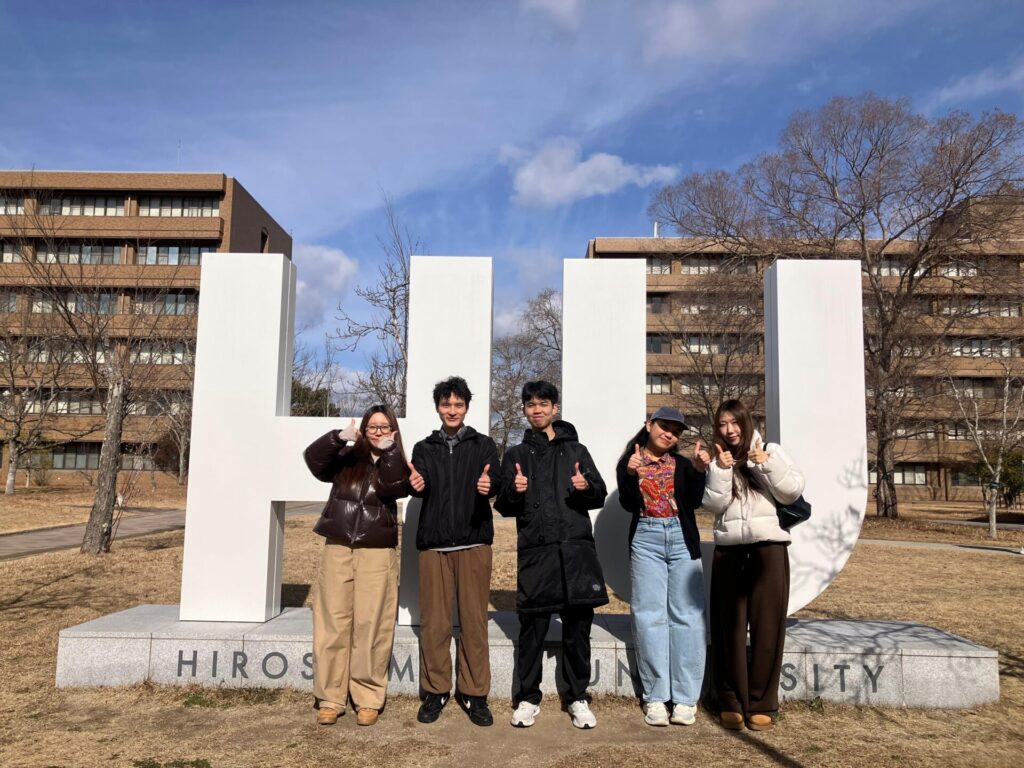
Hiroshima University welcomed five international students for a semester study abroad program during Terms 3 and 4 of the second semester, from Thursday, October 2, 2025, to Friday, February 6, 2026.
The five students who studied at Hiroshima University consisted of one student from Changchun University in China, two students from Hankuk University of Foreign Studies in South Korea, one student from Indonesia University of Education in Indonesia, and one student from Kasetsart University in Thailand.
During their studies at Hiroshima University, the students deepened their learning through classes, visits to facilities, interactions with the local community, and other activities, under the theme of “Developing Internationally Collaborative Human Resources in Asia with an Inclusive Mindset.”
Learning Through Required Courses
The five international students took the required courses for this semester study abroad program, “Basic Theory and Practice of Special Needs Education” and “Study on Japanese Companies and Social Entrepreneurship.” In addition to lectures, they deepened their understanding of the content learned in class through opportunities to visit actual facilities and companies.
Learning the Theory and Practice of Special Needs Education
In the required course “Basic Theory and Practice of Special Needs Education,” the students learned the theories of special needs education and deepened their understanding of inclusive education practices through visits to Shinonome Elementary School and Saijo Special Needs School, where they observed educational settings.
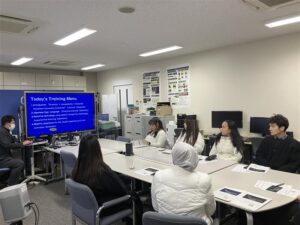
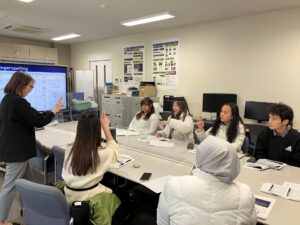
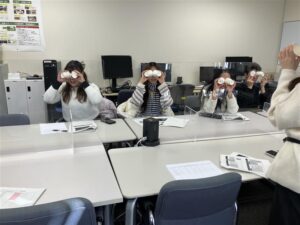
In addition, an internship was conducted at Hiroshima University’s Accessibility Center, where the students learned about the university’s initiatives to support students with disabilities, the current state of support for students with disabilities in Japanese higher education, academic support, and reasonable accommodations. Furthermore, they learned about Japanese Sign Language, finger spelling, written transcription services, and mobility support techniques for people with visual impairments. Through these activities, they deepened their practical understanding of specific support methods for students with disabilities and the development of an educational environment in which everyone can learn more easily.
Internship at the Accessibility Center
Learning About Japanese Companies and Social Entrepreneurship
In the required course “Study on Japanese Companies and Social Entrepreneurship,” the students learned about the initiatives of Japanese companies and social entrepreneurship.
As part of the course, they visited Satake on October 13, Kamotsuru Sake Brewing on November 13, and Hattendo on November 27. Visiting actual companies and learning about their respective businesses and initiatives provided an opportunity to deepen their understanding of Japanese companies.
Introducing Their Home Countries and Universities at Asian Saturday
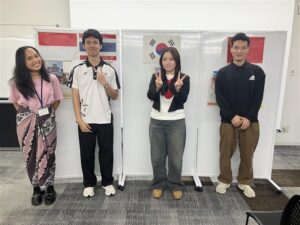
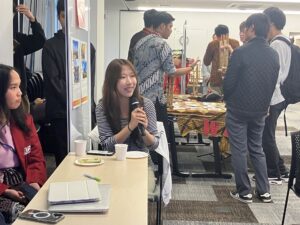
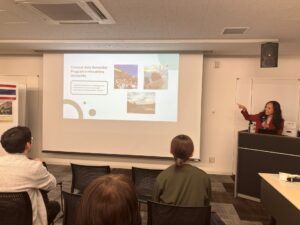
At “Asian Saturday,” an exchange event held on October 25, 2025, in which Higashihiroshima residents also participated, the five international students introduced the cultures and characteristics of their home countries, as well as their home universities.
They shared information about the cultures of their respective countries and university life with local participants, and the event provided an opportunity to deepen mutual understanding of each other’s cultures through interaction with visitors. It was also a valuable opportunity for the international students to share the appeal of their home countries’ cultures and universities and to encounter diverse values through interactions with people from different cultural backgrounds.
Five International Students About Their Study Abroad Experience at Hiroshima University
The five international students who participated in this semester study abroad program about what motivated them to participate, the classes and extracurricular activities that left an impression on them, what they learned through their study abroad experience, and their future goals. Here, we introduce some of the comments shared by the five students.
Reasons for Participating in Campus Asia and Study Abroad Life
-
I decided to participate in the Campus Asia program because I wanted to deepen my understanding of inclusive education and broaden my perspective as a future teacher. I was particularly interested in learning how educational practices differ across countries.
I chose to study abroad at Hiroshima University after learning from my senior that its education program is well respected. I was also drawn to its strong academic environment and the opportunity to experience a different educational culture.
After spending four and a half months at Hiroshima University, I found my experience to be highly rewarding. The campus environment is very supportive, and the teachers are encouraging and approachable. This experience not only strengthened my academic knowledge but also helped me develop greater self-reliance and adaptability.
- I am majoring in Japanese Language and Culture, and I have a broader interest in Asia as a whole. I decided to participate in the Campus Asia program because I wanted to expand the knowledge I gained in my major through direct experience in an international academic environment. Since Hiroshima University is the only Japanese university participating in the Campus Asia program with my home university, I chose to study abroad at HU. My time at Hiroshima University has been a meaningful opportunity to experience a different academic environment and interact with students from diverse backgrounds.
Memorable Classes and Extracurricular Activities
-
“Basic Theory and Practice of Special Needs Education”
This class aligns very well with my major and I learnt a lot about how the special education system works in Japanese schools and even got the chance to visit the school as well.
- Education in Japan and Around the World was the most meaningful class for me because it offered broad perspectives on education systems across different countries. I found the content highly valuable, as it helped me better understand my own country’s education system and consider how certain ideas and practices could be applied.
- Japanese economic history, and the teacher interacts with us a lot.
- The most memorable class I took was the Glocal Internship course. It was especially meaningful because it gave me the opportunity to experience the characteristics of Japanese companies firsthand rather than only learning about them in theory. Through this class, I was able to gain practical insights into Japanese work culture and business practices, which made the experience very valuable.
- The class that left the strongest impression on me was Introduction to Japanese Legal System, which I took as a liberal art course. Although I major in Japanese studies, my home university does not offer classes on Japanese law, so I was happy to have the opportunity to learn about it. The class was discussion-based, and HU law students took it together, which allowed me to hear local students’ perspectives on current legal issues in Japan.
- There were many international events at Hiroshima University, but the activities related to the Campus Asia program were the most memorable for me. Shortly after arriving, I participated in the Asian Saturday event and introduced the Campus Asia program and my university. It was meaningful to share information about the program with other students and interact with people interested in Asian cultures.
- Various clubs and English classes offered by the Global Learning Center at the West Library have greatly improved my language skills.
The Most Challenging Experience
- The most challenging aspect of participating in this semester’s program was the language barrier. Communicating with people who were not comfortable speaking English, while I was still developing my Japanese skills, sometimes made interactions difficult. Although we could understand each other partially, expressing more complex ideas was challenging in certain situations.
- The most challenging part of participating in this semester program was adapting to discussion-based classes in English. Since students from many different countries actively shared their opinions, I initially found it challenging to express my thoughts clearly and confidently. However, through continuous participation, I gradually became more comfortable communicating and engaging in academic discussions.
Personal Growth Through Study Abroad and Future Goals
- After this study abroad experience, I have developed a broader perspective on education and cultural diversity. Studying in a different academic and social environment helped me become more adaptable, open-minded, and confident. In the future, I hope to apply the knowledge and perspectives I gained to my career in education. My goal is to support learners from diverse backgrounds and help create learning environments where everyone feels valued and included.
- After this study abroad experience, I hope to further develop my global perspective and communication skills. Through my time at Hiroshima University, I became more interested in working in an international environment, especially in Japan. In the future, I plan to prepare for employment in Japan and pursue a career where I can contribute to cross-cultural communication and international collaboration.
- After this study abroad experience, I feel that I have broadened my perspective on diversity and inclusion, especially since I interact with the international students more. For now, my goal is to go back to Japan and learn more about Special Education there. I am looking to get an internship/working opportunity on Special Schools there.
Messages for Students Considering Studying Abroad
- For students planning to study abroad, I would encourage you to fully embrace the experience. Be open to new cultures, new perspectives, and new ways of thinking. It is normal to feel uncertain or overwhelmed sometimes, but these moments always lead to the greatest growth. Most importantly, take initiative, stay curious, and allow yourself to learn not only academically but also personally.
- Don’t worry too much. Just be brave and give it a try.
- Studying abroad can sometimes feel unfamiliar or challenging, but it is also a very valuable experience. I would recommend trying to participate in different activities and talk to people from various backgrounds while you are there. Make the most of your time abroad so that you do not leave with any regrets.