Implementation Report on the 2025 Short Term Program in Southeast Asia
Implementation Overview
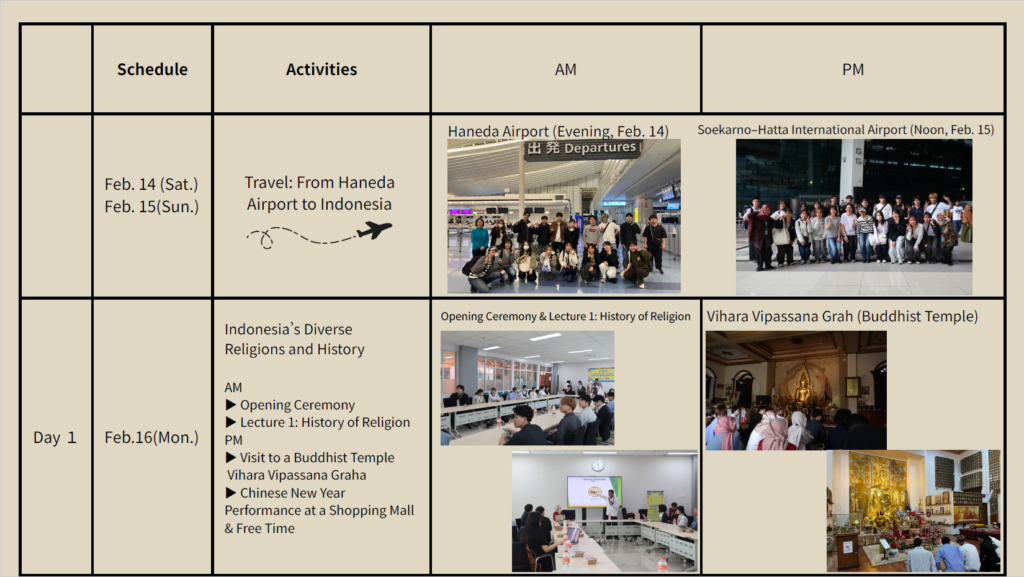
Period: February 14 (Sat.)–February 28 (Sat.), 2026 [14 days]
Participants: 17 students and 3 accompanying faculty/staff members
Indonesia
Dates: February 15 (Sun.)–February 21 (Sat.)
Location: Universitas Pendidikan Indonesia (Bandung)
Theme: Religious Diversity
Thailand
Dates: February 21 (Sat.)–February 28 (Sat.)
Locations: Kasetsart University Sakon Nakhon Campus (Sakon Nakhon Province) and Kasetsart University Bangkhen Campus (Bangkok)
Theme: Religion, Ethnicity, and Minorities
Learning about a Multicultural and Multireligious Society in Indonesia
A total of 21 students, including 17 students from Hiroshima University and 4 students from Beijing Normal University, participated in the program. In addition, 9 student staff members from Universitas Pendidikan Indonesia participated as supporters. The entire program was conducted in English, and students from Japan, China, and Indonesia learned together and interacted through lectures, discussions, group work, and fieldwork.
Focusing mainly on Bandung, Indonesia, the students visited various areas and learned about their respective histories, cultures, religions, and people’s lives. Through these experiences, they had the opportunity to think about a society in which diverse religions and cultures coexist. As students from different cultural backgrounds exchanged their opinions in English, they encountered a variety of values and ways of thinking and learned the importance of respecting diversity and understanding each other’s differences.
In addition, student staff members from Universitas Pendidikan Indonesia supported the various activities. Through interactions with local students, the participants were able to gain perspectives and insights unique to the local community that could not be gained through classroom learning alone.
Lectures and Discussions
In the lectures, students learned about the diversity of cultures, religions, and ethnic groups in Indonesia, as well as inclusion. Participatory activities such as questions and discussions, games, and group work were incorporated, allowing students to deepen their understanding while exchanging opinions with one another.
・Lecture 1: The History of Religion
In addition to learning about the relationship between records and systematization of religions and the invention of writing, students discussed the role of religion in their respective countries in mixed groups consisting of students from Indonesia, China, and Japan. They exchanged opinions on differences and similarities among the countries, including the relationship between religion and cultural traditions.
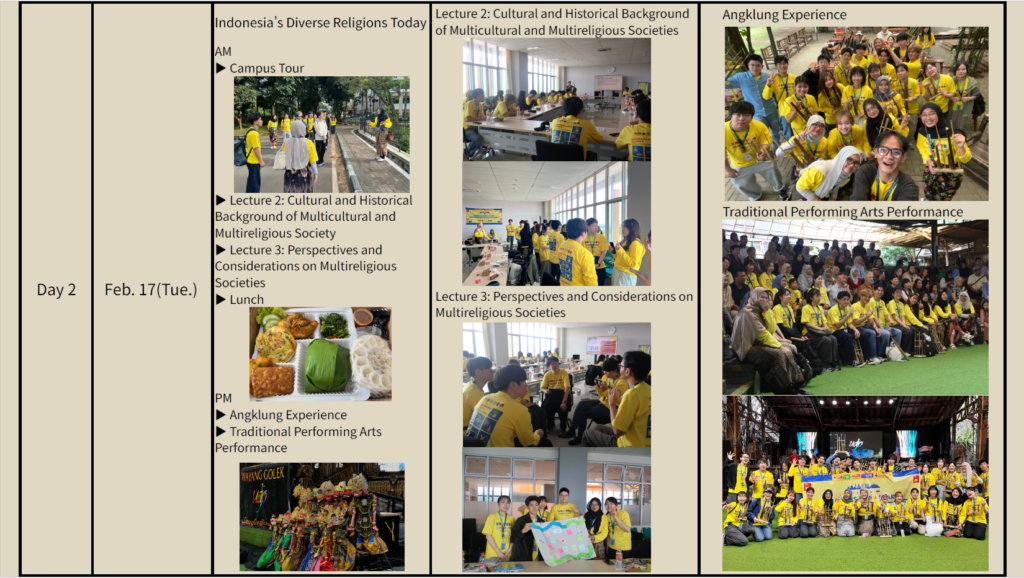
・Lecture 2: Cultural and Historical Background of Multicultural and Multireligious Societies
Students learned about the history of Indonesia, where diverse cultures have developed against the background of trade through the Strait of Malacca and the introduction of Hinduism, Buddhism, Islam, and other religions. In a game-based discussion, they considered the importance of respecting different opinions and being tolerant.
・Lecture 3: Perspectives and Considerations on Multireligious Societies
Students learned about diverse religions in Indonesia and their histories, including Islam, Hinduism, Christianity, Buddhism, and Sunda Wiwitan. In group work, they exchanged opinions on the impact of religious and cultural diversity on social life. At the end of the session, they created vision boards on the theme of “Unity in a Multireligious Society” and gave presentations in their respective groups.
Experiencing Diverse Religions and Cultures Firsthand
Students deepened their understanding of the religions and cultures they had learned about in the lectures by actually visiting temples, schools, and local communities and learning through tours and hands-on experiences. They had the opportunity to encounter a variety of religions and traditional cultures and to experience Indonesia’s diversity firsthand.
・Vihara Vipassana Graha (Buddhist Temple)
Students received a detailed explanation from a monk about the history and teachings of Buddhism. They then toured the Buddhist statues and buildings within the temple under the guidance of student staff from Universitas Pendidikan Indonesia. They also learned how to pray from members of the temple and practiced it themselves, deepening their understanding of Buddhist culture in Indonesia.
・Angklung Udjo: Angklung Experience and Traditional Performing Arts
Students learned about the Indonesian traditional musical instrument “angklung” and experienced playing it together as a group. They learned that angklung is made of bamboo and that the pitch differs depending on the thickness of the bamboo tubes. Each participant was responsible for one note, and they learned how to produce the sound before performing together as a group. During the traditional performing arts performance, they also participated in the music and dancing, experiencing Indonesian traditional culture while having fun.
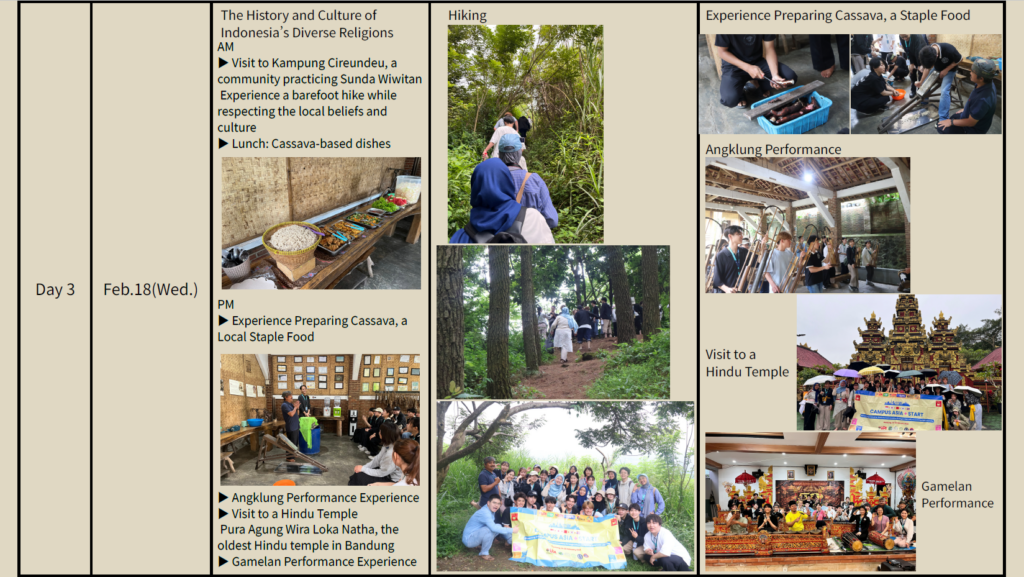
・Visit to Kampung Cireundeu, a Community Practicing Sunda Wiwitan
Students learned about beliefs and ways of life passed down from their ancestors. Sunda Wiwitan is a traditional belief system of the Sundanese people that has continued since before the spread of external religions such as Buddhism and Islam, and the values and ways of life of their ancestors continue to be preserved while interacting with modern society. Students heard from local residents about the lives of people in the community who preserve their beliefs and culture. They also experienced a barefoot hike through a sacred area based on the idea of “connecting directly with the earth (Mother Earth).” For lunch, they tasted cassava, a staple food of the community, and then participated in an activity to process cassava, allowing them to experience firsthand the culture and way of life that have been passed down in the community.
・Pura Agung Wira Loka Natha (the Oldest Hindu Temple in Bandung)
Students learned about the history and cultural role of Hinduism in Indonesia. They deepened their understanding of the influence of Hinduism on Indonesian society and culture, as well as the culture that has been passed down under the principle of “Unity in Diversity.” They also experienced playing the traditional musical instrument “gamelan.” With guidance from the performers, the students played together, coordinating their sounds, and enjoyed the experience while feeling a sense of unity despite it being their first time playing.
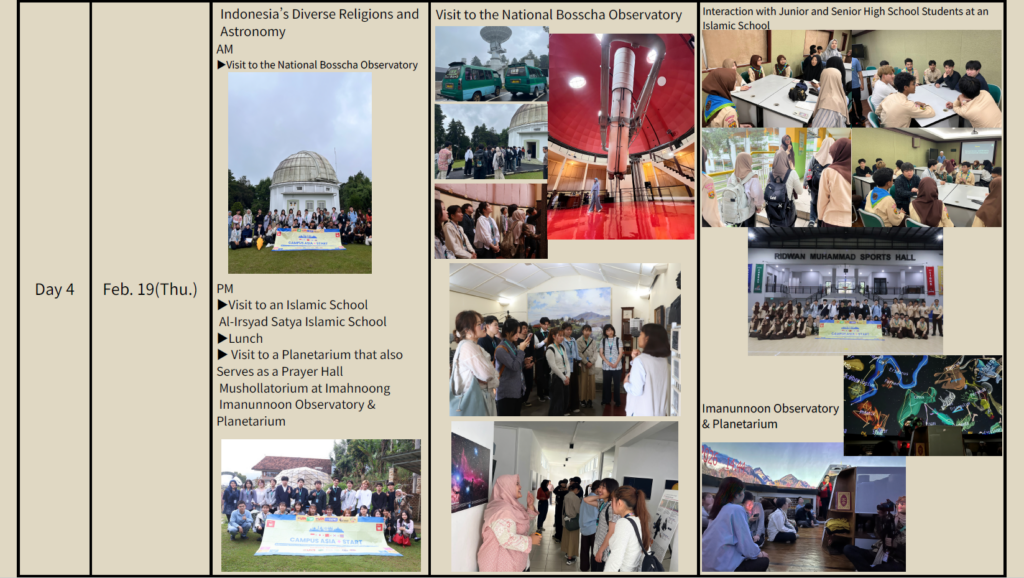
・Bosscha Observatory
Students visited Bosscha Observatory, which is not normally open to the general public and is used for research purposes. They learned about the large telescopes and the history of the observatory and viewed photographs of galaxies and planets. It was an interesting learning opportunity, with students actively asking questions.
・Al-Irsyad Satya Islamic School
Students learned about the school’s educational policies and initiatives during Ramadan and interacted with local junior and senior high school students. They exchanged opinions about school life, culture, and religion, deepening their understanding of Islamic culture.
・Imanunnoon Observatory and Planetarium (Mushola: a Planetarium that also Serves as a Prayer Hall)
Students visited a planetarium that also serves as a prayer hall, known as a mushola, and learned the basics of space and astronomy. They learned about the daytime and nighttime skies and constellations in Bandung, as well as how the movements of the sun and moon are related to prayer times and the Islamic calendar. It was a valuable opportunity to learn about Islamic culture through astronomy.
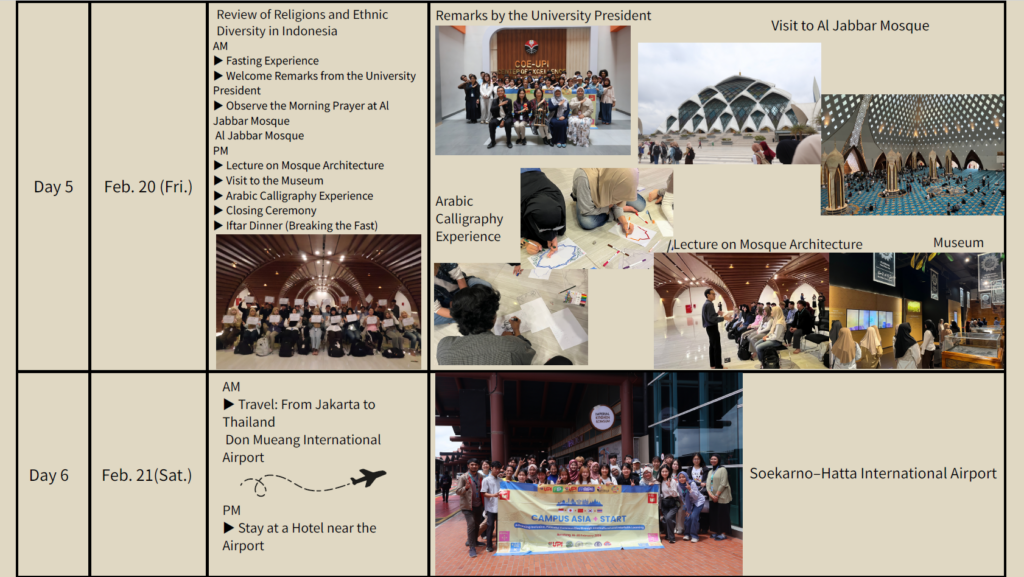
・Al Jabbar Mosque
Students learned about prayer, mosque architecture, and Islamic culture, and visited the Islamic museum and experienced Arabic calligraphy. All activities on this day took place inside the mosque, and for the female participants, it was a valuable experience to wear a hijab for almost the entire day. They also observed that men and women use separate entrances at the mosque and that, during Friday prayers, only men were observed praying in the main hall, deepening their understanding of Islamic prayer practices and the differences in spaces for men and women. During the final reflection session, a representative student gave a presentation confidently in English, demonstrating the growth they had achieved through the program.
Learning about Thailand’s Multicultural, Multiethnic Society and Social Challenges
Learning about the Multiethnic Culture of Northeastern Thailand — Sakon Nakhon
Students visited Sakon Nakhon, located in the Isan region of northeastern Thailand, and learned about the region’s history, culture, and natural environment. Surrounded by the Phu Phan Mountains, Sakon Nakhon has a history of approximately 3,000 years and is a region where agriculture, including rice and rubber cultivation and livestock farming, is thriving. The region is also known for local specialties such as indigo-dyed textiles and beef, while Nong Han Lake, the second-largest freshwater lake in Thailand, is an important wetland for the region.
Through lectures and fieldwork, students deepened their understanding of the multiethnic culture that developed through historical interactions with Laos and Vietnam, as well as traditional clothing, festivals, and beliefs related to nature. They also learned about traditional cultures passed down through generations and the ways of life that have developed in harmony with the natural environment.
・Lecture on the Culture, Religion, and Ethnic Diversity of Sakon Nakhon
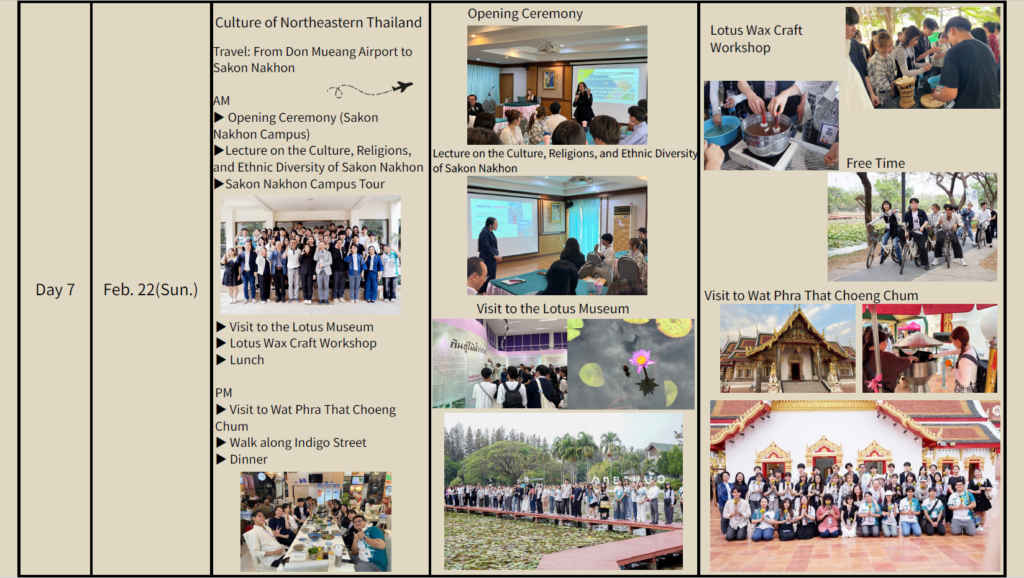
Following the opening ceremony, students attended a lecture on the history, culture, religions, and ethnic groups of Sakon Nakhon. They learned how the region’s multiethnic culture has developed and deepened their understanding in preparation for the fieldwork.
・Lotus Museum and Garden
Students visited the university’s lotus garden and learned about the collection and research of various lotus and water lily species. They received explanations about various varieties, including those that bloom during the day and at night, as well as the characteristics of species native to Thailand and hybrid varieties. They also experienced the making of wax crafts shaped like lotus flowers, which are used as decorations for Buddhist ceremonies.
・Wat Phra That Choeng Chum Worawihan (Temple)
Students visited this historic temple and learned about its history and Thai Buddhist culture. They received an explanation of the prayer practices observed by local people and experienced the entire process of worship: holding marigolds and incense sticks, walking around the temple three times while praying, lighting the incense and praying again, and finally offering the incense and marigolds at a designated place. By experiencing the actual prayer practices, students learned about the faith of local people and the role of the temple in the local community, deepening their understanding of Thai religious culture.
・Phu Pham Development Study Center (Regional Development Center)
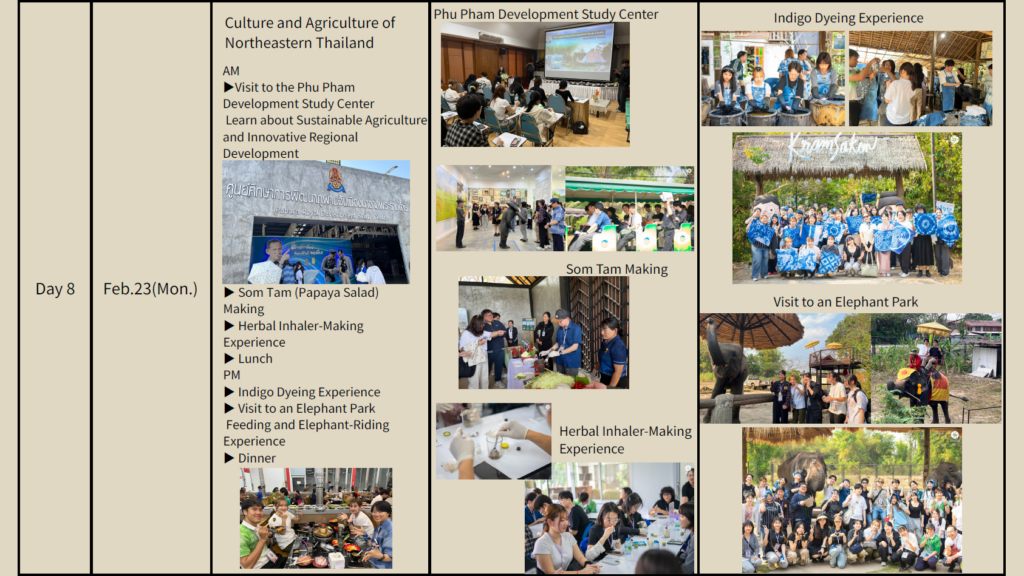
Students visited the Royal Development Study Center, established in 1982, and learned about regional development initiatives addressing issues related to water, forests, soil, and other areas. The center works in cooperation with multiple government agencies to improve the natural environment and the lives of local people through research, training, and outreach activities. Through making som tam, experiencing herbs, and touring the facilities, students deepened their understanding of sustainable initiatives rooted in the local community.
・Indigo Dyeing Experience
Students learned about traditional indigo dyeing using natural indigo that has been passed down in Sakon Nakhon and experienced dyeing cotton fabric. They learned that it takes approximately three months to prepare the dye and that the resulting color is resistant to fading. They also experienced creating their own patterns by folding, tying, and rolling the fabric to leave certain areas undyed. Each student enjoyed the dyeing process while coming up with their own designs, providing an opportunity to experience a traditional technique closely connected to the region’s natural environment and culture.
・Elephant Park
Students experienced Thai elephant culture by feeding elephants and watching elephant performances. They also enjoyed the opportunity to interact directly with the elephants.
・St. Michael’s Church
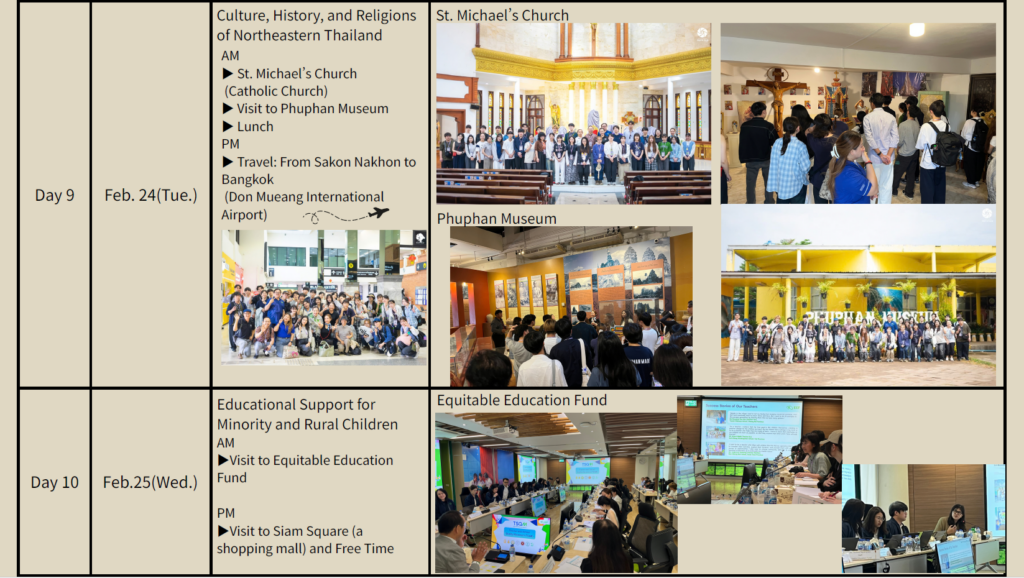
After listening to a pastor speak about the history of the church and Christianity in the local community, students visited the museum located in the basement of the church. They learned about the history of the church, including how approximately 20–30 Catholic families migrated to the area in 1884 and established the church, and how it developed with the support of missionaries. They also learned how the Catholic community, although a minority in Thailand, coexists with other religions through cooperation.
・Phuphan Museum
Students learned about the history, culture, natural environment, and agriculture of Sakon Nakhon. By learning about the region’s history and the lives of its people, they deepened their understanding of the culture that has been passed down to the present day.
Considering the Coexistence of Diverse Cultures and Religions and Social Challenges — Bangkok
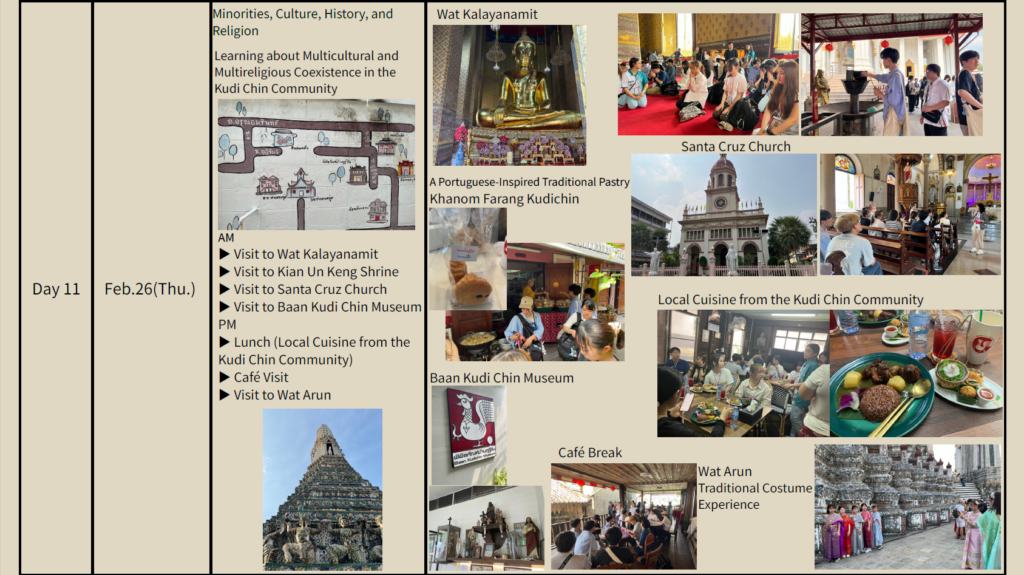
In Bangkok, students visited the Kudi Chin community and learned about the history of the coexistence of different cultures and religions. Located along the Chao Phraya River, this historic community is home to diverse cultural and religious traditions, including Portuguese-Thai culture, Buddhism, Christianity, Islam, and Thai-Chinese culture. By visiting temples, churches, and museums, students experienced the unique characteristics of a community where diverse cultures have coexisted.
In addition, through a lecture by the Equitable Education Fund (EEF), students learned about educational disparities caused by factors such as poverty and geographical conditions, as well as initiatives to address these disparities. They also learned about Thai history and traditional culture by visiting Wat Arun in traditional Thai clothing and the museum at Kasetsart University’s Bang Khen Campus.
・Lecture by the Equitable Education Fund (EEF)
Students learned about the Equitable Education Fund (EEF), which works to address disparities in access to education. They learned about initiatives to support students facing educational disparities due to factors such as poverty and geographical conditions, as well as scholarships, research, and policy development. Through these examples, they considered approaches to addressing social challenges through education.
・Kudi Chin Community
Students visited the historic Kudi Chin community along the Chao Phraya River and learned about the history of a community where diverse cultures and religions have coexisted, including the cultures of Portuguese-Thai and Chinese communities, as well as Buddhism and Christianity. They visited Wat Kalayanamit, Kian Un Keng Shrine, established by Chinese immigrants from Fujian, and Santa Cruz Church, established in 1770, experiencing the respective cultures and religious traditions. At the Baan Kudichin Museum, they learned about the history of multicultural exchange during the reign of King Rama III and about historical figures associated with the community. They also enjoyed panoramic views of the Kudi Chin community and the Chao Phraya River from the museum’s rooftop. Through visits to temples, churches, and museums, students experienced the unique characteristics of a community where diverse cultures have coexisted.
・Siam Square
Students visited Siam Square, a busy commercial district in Bangkok, where they spent their free time with student staff and deepened their interactions with local students.
・Wat Arun
Students visited one of Thailand’s most iconic temples and learned about its history and traditional culture. By visiting the temple dressed in traditional Thai clothing, they were able to experience Thai culture in a more direct and immersive way.
・Kasetsart University Bang Khen Campus Museum
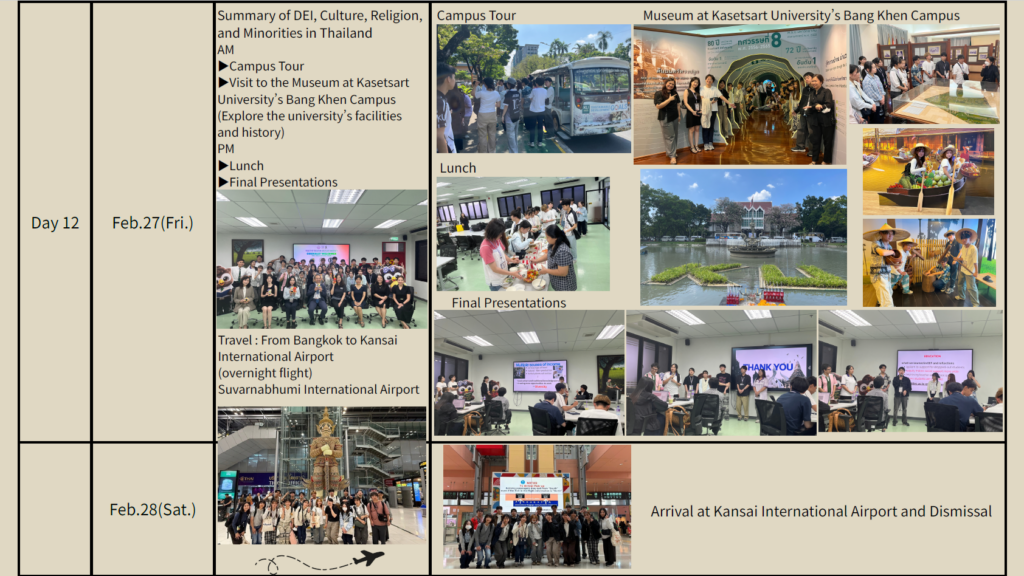
Students learned about the history of Kasetsart University and Thai culture. It was an opportunity to deepen their understanding of Thailand’s education and culture by learning about the university’s history and the cultural heritage of the local community.
Final Presentations Incorporating Diverse Perspectives
At the end of the program, students from Japan, China, South Korea, and Thailand formed mixed groups and gave presentations on the theme of Diversity & Inclusion.
Through this activity, students learned that even when addressing the same theme, their perspectives and ways of thinking can differ depending on their cultural backgrounds. It was a valuable opportunity to create a shared outcome while respecting each other’s differences. By collaborating with students from different countries, they developed the ability to understand diverse values and perspectives and work together with people from different backgrounds.
Learning Outcomes from the Program
Through lectures and fieldwork, students had the opportunity to experience firsthand societies where diverse cultures, religions, and ethnic groups coexist and to reflect on Diversity & Inclusion.
As a prerequisite for participating in the program, students were required to complete COIL-based education and e-START as pre-program learning. Through online learning, they studied the fundamentals of Diversity & Inclusion. Building on this foundation, the study-abroad program allowed students to visit the local communities in person and encounter diverse cultures, religions, and ways of life, enabling them to deepen the knowledge and perspectives gained online in a more concrete and practical way. In addition, students who had already worked together in groups during the online pre-program learning had opportunities to meet and work together in person, creating a learning and international exchange experience that combined online and face-to-face activities.
Furthermore, the program went beyond exchange between Hiroshima University and a single host university. With students participating from multiple universities, including Beijing Normal University, Hankuk University of Foreign Studies, Universitas Pendidikan Indonesia, and Kasetsart University, the program facilitated multilateral international exchange that extended beyond bilateral exchange. By learning and exchanging ideas with students from different countries and cultural backgrounds, participants were exposed to a variety of values and ways of thinking, providing an opportunity to develop an attitude of understanding and respecting different perspectives.
In addition, past participants of Campus Asia programs supported the program as student staff, creating a cycle in which program participants take the next step from learners to supporters of subsequent programs. By taking on a role in supporting the learning and interactions of younger students, rather than simply participating in the program, students also developed a greater awareness of their active role in international exchange.
In this way, the program organically connected learning and international exchange by combining online pre-program learning, experiential learning at the host destinations, multilateral student exchange, and participation in program management as student staff. Through this continuous process of learning and exchange, the program not only deepened students’ intercultural understanding but also contributed to fostering an inclusive mindset that respects different values and embraces diversity.
Program Schedule